Saturday, September 10, 2011

Experiences and Impressions from Clinical School (Part 2: Clinical Patient Interactions)


I haven’t spoken to as many patients compared to medical students at the other Clinical Schools, but I feel that I’ve spoken to enough to make some primitive observations. I have had reasonably positive experiences with most of the patients that I’ve spoken to, in that they’ve never been aggressive to me or abused me, however the accuracy and clarity of what they say varies, so in terms of medical content for collecting data, the quality varies. This is probably why a few nurses tell me that some patients are “better historians” than others.
Lack of Insight or Denial
Some patients are rather lacking in insight into their medical conditions. While I understand that they’re not doctors or nurses or necessarily have a background education in health, I would’ve thought that they know about a few aggravating factors or physiological mechanisms regarding their condition as the doctors explain to them (in a more layman manner, less jargon). I’m not sure if this phenomenon is more prevalent within the public hospital system, though I suspect it is.
A classmate and I met a patient who was being hospitalized for an increased frequency of tonic-clonic seizures and was already diagnosed with epilepsy several years ago. After he asked her about her history of presenting complaints, he then proceeded to ask routine questions. When asked about alcohol consumption, she said she drinks a slab of beer (24 cans/stubbies) every weekend. When asked if she felt that the beer might’ve been the cause of more frequent seizures (alcohol usually lowers seizure thresholds), she said “Nah, the beer’s alright.”This was despite taking into consideration numerous psychosocial factors, the doctors already informed her in a polite manner suited to her preferences of the great risks associated with binge drinking for someone with epilepsy.
Another patient that I saw with a classmate said he was diagnosed with hypertension when asked about other active health problems, but he claims that it’s because he has successful children (one of them a doctor), and that he leads a happy life which causes it. At the time I found this very hard to believe, seeing that his son has a medical background, and the patient himself also taught Science (biology/chemistry/physics) for numerous years, so should’ve understood the basic physiology of blood pressure. I thought it didn’t make sense to have hypertension from having a happy life, unless he happened to be using psychostimulants or certain antidepressants (especially MAOIs) every day. He also said he was diagnosed with Type II Diabetes, and he was overweight. By Occam’s Razor, it seems implausible that happiness alone causes high blood pressure; on the contrary it’d be more likely to be constant stress, poor diet that’s high in sodium or obesity. I checked his patient files. No surprise, he was diagnosed with Depression as well and was prescribed an SSRI antidepressant. At the time, I was quite annoyed coz I felt that he was deceiving me, but I spoke to other people about this issue, and they suggested that he may be feeling happier instead primarily due to the antidepressants, which allow him to be more euthymic and appreciate what he has in life (family). While he might not have understood the mechanism of antidepressants in making him happier, I felt that it was most likely that he was in true denial of the real causes of his hypertension, seeing that the SSRI he was on wasn’t supposed to significantly increase blood pressure.
For other patients, when I ask them if they have any other medical conditions, they say no, but their patient files state that they have hypertension, Type II Diabetes or hypercholesterolaemia. How a patient didn’t regard Type II Diabetes as a medical condition is beyond me, but I’ve been told by other people that Type II Diabetes has existed in many patients for 1 or more decades that they’ve grown accustomed to it, and no longer regard it as abnormal. This is why from now on, I always ask “Do you have high blood pressure/Diabetes/high cholesterol?” after asking “Do you have any other medical conditions” and them responding “No”.
At the time I’ve been very tempted to confront these patients and point out their misinterpretations or reduced insight into aggravating factors, but was told that this is the job of the doctors and nurses to do, not the Medical students. Therefore I’ve restrained myself from doing so, which is frustrating for me internally, but I’ve gradually accepted it as part of life, and decided to focus on learning more about their medical issues by reading their patient files, as opposed to just getting bitter and angry about it.
Asking Open-Ended Questions
I initially had the tendency to ask direct, specific questions to patients, but have been told that this may make the patients (majority NT) feel that they’re being judged subtly. They explained to me how certain direct questions can make patients feel that you’re judging them, but I felt that these impressions were excessive and I had no intention of judging/denigrating them, and that the patients are just being whiny and overly sensitive. After all, many NTs obsess about appearances and “keeping up with the Joneses”.
However after the first few weeks of Clinicals, I’ve realized the importance of asking open-ended questions. I know that it goes against my Aspie-trait of automatically focusing on details, and I originally thought that asking open-ended questions would mean that I’m “selling out” to conform to NT standards like a sheep, but I’ve realized the systematic usefulness of asking open-ended questions, which is probably the only Aspie-friendly excuse (to me) for using it.
For example, when asking about someone’s cigarette use, by asking “Have you ever smoked cigarettes?” at the start allows you to step into the topic broadly. If the patient says yes, then you can ask if they’re still smoking, when they quit smoking (if they quit already), and how much they smoke/day. If I had asked “How many cigarettes do you usually smoke per day?” as my first question, then I may have missed out on their previous history of smoking had they said “None”.
Therefore it is more systematic and easier to remember for some topics if I ask them from a broad/open-ended--> detailed fashion. I can then remember the flowchart of questions for that topic in a specific order. The questions are also ordered in a way to provide the least offensiveness and “judgmental impression” that is experienced by NT patients, so in fact a flowchart of questions from broad/open-ended --> detailed “Hits two birds with one stone” in that it appeals to both NT and ASD mindsets. Most NT patients wouldn’t be offended if you told them that you’re going to be asking routine questions, and then asked them if they’ve ever smoked cigarettes. However they might’ve felt judged if you asked “How many cigarettes do you usually smoke per day?” at the very start coz they feel that you assume that they smoke cigarettes, and especially if they have some sort of cancer (especially lung cancer), that the cigarettes are a contributing factor to their medical condition, and that the question is too confronting as it addresses their “fault” in smoking, hence making them feel guilty/bad as well.
My example for smoking history is below (click on picture for enlarged version):

I was lucky in that I managed to follow this flowchart for smoking (and a similar one for alcohol) after a few weeks. It was initially surprising to me when I learnt about other sensitive psychosocial factors that can be mentioned/triggered when I perform the history for both.
Soon after I followed this flowchart, I spoke to 2 patients.
For 1 patient, when I asked an elderly woman “have you ever smoked cigarettes?”, she said she used to smoke when she lived with her husband, and then she quit to make her husband happy, and then she started again after her husband died, and she started crying.
I felt awkward and sorry for her. Admittedly I didn’t know the direct cause of her crying. I couldn’t tell if she was crying coz she started smoking again, or coz her husband died. An (NT) teacher who was sitting down and observing my interaction with her said that it was due to the latter (husband died), and that asking the smoking question reminded her of her husband’s death. I was so surprised that asking an open-ended question could’ve released so much info from her, but she may have been an exception due to specific familial circumstances that happened to have smoking intertwined with it.
I then remembered the ICM video about what to do when a patient cries: you’re supposed to stay quiet and maintain a pause for at least 10 seconds while handing a tissue box to them to take a tissue to wipe their tears. I did that, and the patient said thank you. The teacher then asked her if she was alright with continuing the conversation, and she said yes. And so the interview proceeded.
The other patient I spoke to on another day, I later asked “have you ever drank alcohol?” and she said “Never in my life!!!” She then said that she grew up in a household where her Dad was an alcoholic, and would be abusive to her, her siblings and her mum. She had a traumatic childhood and to this day never drank alcohol. She said that she finds it very upsetting and judgmental when other doctors ask her “How much alcohol do you drink?” because they automatically assumed that her liver cirrhosis was due to alcoholism and that it reminded her of her abusive Dad, when in reality there must’ve been some other aetiology to it. She was actually kinda upset that I asked that question, but the teacher (who watched my interaction again) did tell her that I stated it was a routine question and that it wasn’t meant to judge her. She later calmed down and proceeded with the interview.
I think after these 2 incidents, it really “hammered” it in that if I had asked the direct/detailed questions first instead of the open-ended ones (according to the flowchart), I would’ve gotten into deep shit or created a lot of friction/tension with the patients.

Saturday, September 3, 2011

Experiences and Impressions from Clinical School (Part 1: Relatively Insufficient Patient Contact)

I may type my anecdotes and impressions of my Clinical School so far in a disjointed manner.

I have just completed my 1st Block (Neurology/Ophthalmology/ENT) for Clinical School. In my previous entry regarding starting Clinical School, I said that the 2 weeks felt like it went for a really long time, perhaps due to the very stressful incident that occurred then (which I’m not allowed to further discuss for legal reasons), which seemed to slow down my perception of time, like undergoing massive Adrenaline rushes for several days or being under the influence of Cannabis. On the contrary, the remaining weeks of this block seemed to pass by rather quickly, and I’m feeling both stressed out and slightly relieved about it.

A Criticism of my Clinical School (--> Relatively Insufficient Patient Contact)

My impression is that each Block isn’t long enough, and that 6 weeks is definitely not enough time to see enough patients and learn the knowledge required to pass exams unless you spend the vast majority of your spare time outside Clinical School exhaustively studying and reviewing notes as compensation. This issue is exacerbated by the idiosyncrasies of my Clinical School, of which I was initially impressed by, but subsequently partially disappointed. It was supposedly the most didactic of all Clinical Schools (for Melbourne Uni MBBS), but it’s didactic in the “wrong” style.

For further explanation of being didactic in the “wrong” style, I mean that there’s technically more structure as there are more planned tutes and lectures throughout the week, but many of them are for topics that aren’t directly relevant to my current Block. While it’s true that many aspects of medicine crossover into each other (eg Pneumonia involves both Respiratory System and Infectious Diseases), the topics that are discussed are hard for me to apply on in terms of student-patient interactions, and don’t particularly benefit me in understanding the topics of my current block, ie “adding extra food to my plate” when I’m already overloaded with other stuff to learn.

For example, on Monday 7:30 AM, we always have a lecture relating to Orthopaedics and how different arm and leg fractures occur, and how it gets managed. Sure, this lecture would be beneficial to the students who are doing their Orthopaedics Block, but it’s not very helpful for students outside of that Block, and furthermore it’s even less helpful when they don’t even provide any preliminary anatomy lectures so everyone could at least have a general idea of what is going on. I think it’s asking too much of the medical students (outside of Orthopaedics Block) to study bone/joint/muscle anatomy when they’re really busy studying other things. I don’t gain much out of these lectures as I haven’t done the preparation beforehand, and I hate waking up really early to go to it (yes, lectures are compulsory to attend at my Clinical School). IMO they should only make the lecture compulsory for the students doing Orthopaedics, and only make “irrelevant lectures” compulsory for everyone if the medical condition is very common among Australian patients, eg Type II Diabetes.

Now, consider this and add in the following factors that are/aren’t intrinsic to my Clinical Hospital:

- “Irrelevant lectures” x 5 /week

- 1 or 2 “wishy-washy” tutes / week (ESPECIALLY the Empathic Practice ones which isn’t being examined on and doesn’t didactically teach polite bedside manners / professional etiquette)

- Often being unable to speak to a patient and/or do physical exams on them coz they just happen to be sleeping/with relatives or other doctors/away to undergo extra investigations/tired of speaking to medical students.

- Lectures/tutes/clinical visits often running overtime and being placed and spaced out on the timetable in an inconvenient fashion, occupying the “best times” to speak to a patient, and you often don’t have enough time in between to sufficiently interview them, if you even manage to get one in the first place.

- A curfew in which you’re not supposed to stay at the hospital after 6:30 PM (absolute latest) on weekdays, and not allowed to visit the hospital on the weekends or during holidays if you wanted extra patient contact. I understand that many patients are tired and want to rest on the weekend, but isn’t it possible to at least allow a 3 hour time-slot for students who want to visit the hospital on Saturday/Sunday as compensation for reduced spare time during weekdays? I didn’t think it’d be too overwhelming.

All of this results in SIGNIFICANTLY REDUCED OPPORTUNITIES FOR PATIENT CONTACT (COMPARED TO OTHER CLINICAL SCHOOLS) given the unpredictability of the ward setting and the nature of the patients, and is extra frustrating coz I’m compelled to go to lectures and tutes that don’t benefit me directly when I could be using that time to be in the library reading relevant books, or on the wards seeking/speaking to patients. Typically due to the circumstances, there are about 2 weekdays/week in which I don't speak to any patients at all. It feels a bit disorganized, and I feel like I’m being restrained, and I feel further anxiety and “injustice” due to the fact that we are required to log in a minimum amount of “long case quality” patient data by the end of Semester 9 but they didn’t provide a conducive environment for conveniently doing so .

It has reached the extent, where I feel like I need to spend every bit of spare time scavenging for the “good patients” who aren’t confused, have English as a 1st language, aren’t sleeping or away for investigations, and are willing to talk to medical students. The number of “good patients” on the ward (out of around 30 Neuro patients) vary each week due to patients being admitted into the ward and being discharged later on, but there’s this drive in me to want to be the earliest student to speak to them for fear of them being “sick of speaking” to medical students later on. I apologize for my behaviour which may be perceived to be selfish and even “gunner-ish”, but I’ve noticed that if I don’t be proactive to a degree, the patients will just be “taken” by other medical students and it’ll be harder for me to get a suitable patient to speak to so I have good data to log in. It also doesn’t help that the total [students : ward patients] ratio is around [10 - 18 : 30] , which means that saturation of the “good patients” occurs pretty quickly during each week.

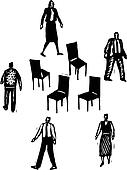
It feels like there’s an extra competition not directly mentioned by the Clinical staff, where you have to “fight” to get “good patients” to speak to. The closest game analogy I can make to this is MUSICAL CHAIRS but with some basic rule variations:

(Picture taken from http://photos1.fotosearch.com/bthumb/ARP/ARP113/Mus_Chr1.jpg)

- The music “plays” when everyone doing a certain Block is in a lecture/tute (compulsory).

- The music “stops” when there’s spare time so students can go onto the wards to seek/speak to patients.

- The chairs in one pile represent the “total” amount of willingness/tolerance that a patient has to speaking to medical students. This can range from 0 chairs for patients that are confused/in a coma, to perhaps 10 for patients that happen to be very chatty and in a good/optimistic mood (despite their medical condition).

- Students may work in pairs/triplets and speak to a patient while the other (1 or 2) student/s listen and write notes on what the patient is saying. Once a single chair is occupied (via student/s interviewing a patient), no other chairs may be occupied during that time.

- After a "significantly long" conversation with a patient has been completed, remove 1 chair. If several physical exams and systems reviews have been conducted, remove another chair.

- Total number of chairs may be replenished or reduced overnight depending on the progression of patient’s medical condition, and how much undisturbed time (by medical students) they have.

- Once number of chairs reach 0, patient is no longer accessible to students for conversations/physical exams.

- A “spare chair” for a specific patient as back-up may be provided for a medical student (even if main total is 0 chairs) if he previously engaged in a very engaging and enjoyable conversation with a patient and the patient thoroughly appreciated his company.

I have also created a few terms to describe the phenomena of this competition:

Stealing/Miss: When other medical students had conversations with a patient (especially a “good” one) and you were unable to speak to him because he has become “saturated” already.

Saturated/Depleted: When a patient has spoken to enough medical students up to his tolerated level, and can’t/no longer wishes to speak to any students anymore. Ie chairs --> 0.

Occupied: When a patient is currently being spoken to by a medical student, doctor, nurse etc.

Penetrating/"being popular": When a patient is being seen by multiple medical students throughout most/all spare time during the day. In most patients, their chairs would’ve decreased a lot by evening. "Penetrating" supposedly has an alternative meaning, so I would use "being popular" in public.

Quickie/Mini: A short conversation with a patient, lasting around 15 minutes or less, just to get a basic idea of his history of presenting complaint. A Quickie/Mini minimizes the chances of the conversation being considered “significantly long”, and thus minimizes the chances of 1 chair being deducted.The term "Quickie" has another meaning, so I tend to use "Mini" in public.

Kara (): Empty, mainly in reference to an empty bed (ie patient isn’t there).

Ikki (一気): In one go, mainly in reference to having a long conversation with a patient covering the presenting complaint and general medical history, along with performing 1 or 2 physical exams with their consent.

Renzoku (連続): Continuous, mainly in reference to searching for a suitable patient to speak to, moving in a consecutive order around the ward.

Tenpai (聴牌): “Fishing”, when you conduct a significantly long conversation with a patient, and perhaps performing 1 physical exam as well, but you’re still missing out on a few medical details (that you forgot to ask or the patient doesn't remember), ie a small step away from having sufficient amount of patient data to log in.

Quoted in New Scientist Article Regarding Trial TMS for ASDs

I was contacted by Linda Geddes, a writer for the New Scientist magazine regarding my experiences with TMS (Transcranial Magnetic Stimulation). She asked me 4 questions and for permission to quote a bit from my entries regarding my experiences. The article is available in the New Scientist magazine (August 27th 2011 edition, No. 2827) if you're able to get it at a store/library.

While she didn't misquote me, she left out a lot of detail due to word limits etc, and I felt that she didn't fully express how I felt, and gave the impression that ASDs were primarily about social issues and empathy when in reality it's a condition that completely changes the way in which one processes information, leading to subsequent symptoms and effects in behaviour etc. Below are my complete answers (at the time) to her questions:

1. How did you hear about the trial, and what made you want to get involved?
Very soon after getting officially diagnosed with Asperger Syndrome (at age 21) in May 2010, I was extremely relieved to understand numerous causes of my difficulties in childhood and adolescence. In addition to obtaining numerous books regarding ASDs (Autism Spectrum Disorders) prior to and soon after the diagnosis, I also checked Mr. Tony Attwood’s home page (international expert on AS/HFA) as my initial reference website for Asperger Syndrome.
As a medical student, and Neuroscience being one of my special interests, I was very interested into learning about the Neurological basis of AS and HFA, and finding out what research studies were being conducted. Several neurological studies and double-blinded treatment trials on AS/HFA individuals have already been conducted with peer-reviewed papers published (also available on Pubmed) in the past 15 years or so, but the studies were often “unsuccessful”, the study samples were often rather small (N < 20) or the plethora of neurological/psychological theories were a bit dubious to me.
I looked at the “Research Studies” section of Tony Attwood’s site to see what research was currently conducted internationally, and most particularly in Australia. I was very excited to see that a TMS (Transcranial Magnetic Stimulation) trial was being conducted in Melbourne at the Alfred Psychiatry Research Centre to see if rTMS (repetitive TMS) of a specific part of the brain (mostly Medial Prefrontal Cortex + Anterior Cingulate Cortex IIRC) would improve social intuition in adults with AS/HFA.
I wanted to take part in this study coz the rTMS treatment may symptomatically improve my social intuition (eg intuitive empathy in regards to non-Autistic people, reading facial expressions rapidly) so I wouldn’t have to constantly exhaustingly learn social skills at an intellectual level. I was very willing to be a “guinea pig” and make a contribution to ASD research by being 1 of 20 volunteers for this exclusive and pioneer rTMS trial, so hopefully I’ll help the researchers become one step closer to figuring out the neurological basis of Asperger Syndrome.
HOWEVER, I was very concerned that the rTMS treatment would affect my other Asperger traits, some which I value and consider an advantage, such as my hyperfocus ability, intuitive honesty, integrity and strong ability to see details. I wanted improved social intuition but not any other parts of my Asperger’s to be affected. I did a Pubmed search regarding TMS and Asperger / Autism, which only resulted in 2 or 3 papers at the time IIRC, none which were directly relevant to social effects.
A Google search indicated that rTMS trials were also being heavily conducted in 1 other place in the world, which was the BIDMC (Beth Israel Deaconess Medical Hospital) in Boston. More importantly, I thoroughly read the account of John Elder Robison (an author with AS who published his autobiography “Look Me in the Eye”) whose blog entries in early 2010 thoroughly described his experiences of taking part in the BIDMC rTMS trials, whom in conclusion described improved “sociability” while still preserving his other Asperger traits, so the rTMS seemed sufficiently selective for me. His blog entries however didn’t mention which parts of his brain was being targeted, and the Alfred trial may be targeting a different area, so I had to contact Dr. Peter Enticott of the Alfred for an extensive preliminary interview to gather extra details about the trial.
I was content with the way the rTMS trial was being conducted, and I had a strong prediction that the rTMS wouldn’t totally remove my AS, and may potentially improve my intuitive social abilities, so I agreed to take part in this double-blinded treatment trial.
2) How long have the effects lasted on you? And do you feel different as a person? What is the biggest change?
It turned out that I was part of the placebo treatment group in my 2-week rTMS trial in Monday 2nd August – Friday 13th August 2010.
I was offered the TRUE rTMS treatment in 15th – 26th November 2010, in which I definitely felt effects soon after.
I only received one definite effect from the true rTMS treatment, which was painless eye contact. I no longer have pain looking at people straight in the eyes when speaking to them, or them speaking to me. It literally doesn’t hurt or feel “piercing” anymore, and I don’t automatically feel anxious or threatened when looking at somebody’s eyes even though I knew that they weren’t going to hurt me. In the past, the only times where I could have painless eye contact with anybody was when I was under the influence of CNS depressants such as alcohol and benzodiazepines, but now I can have painless eye contact when I’m sober.
I was extremely surprised that the rTMS on the Medial Prefrontal Cortex and Anterior Cingulate Cortex had effects on my eye contact, as previous info that I read regarding those 2 regions through medical textbooks and literature don’t really discuss about it. Personally I’m supportive of more double-blinded rTMS trials to further investigate the functioning of these and other brain regions of ASD individuals.
I still have difficulties in intuitive empathy and certain language pragmatics, so I still have to learn about social issues manually as if it was an academic subject like a foreign language. I still have difficulties communicating with patients in a smooth manner, so I have to compensate by memorizing a large number of polite phrases and responses, to simulate the appearance of “politeness”, “empathy” and “professionalism”.
I have manually learnt to read certain facial expressions, but it’s still hard for me to read them on the spot in conversations when my mind is automatically focusing on the verbal words, and it’s hard for me to multitask different modes of communication. I still have difficulties with executive functioning and still strongly prefer plans and routines, even though the unpredictability of the Hospital environment makes me rather irritable. My sensory issues still exist at the same (mild) level, and I didn’t gain or lose any synesthesia abilities (I have ordinal-linguistic personification). I still space out a lot and have trouble modulating the volume of my voice in a conversation (especially too loud). I’m still quite bad tempered and have to manually suppress my rage in public when little things irritate me.
Nevertheless I’m extremely pleased that I gained the ability of painless eye contact only, and it hasn’t waned. When I talk to staff and patients at the hospital, they don’t think I’m ignoring them coz I’m looking at them during a conversation. The painless eye contact also means that I’m less distracted by the “pain” (in the past) and can attempt to use more of my cognition to read their facial expressions or look at their mouth (partially reading lips) without having to mentally block out the discomfort of eye contact.
I’m also very pleased that the rTMS didn’t interfere with my other Asperger traits, so I still feel pretty much like an Aspie (I definitely do not feel “Neurotypical” at all), but with a reduction in daily anxiety previously due to eye contact. I still get anxious about other things, but I have benefitted from having one anxiety-inducing factor removed.
3) In your first blog you talked about your worries about betraying the ASD community by having this treatment. How do you feel about that now?
When exposed to the Autistic Community (especially in the Western World), it becomes EXTREMELY obvious that there are several major dichotomies:
a) The “Neurotypicals” vs the ASD individuals.
b) “Pro-Neurodiversity” / Anti-cure vs “Curebies” (people who want a cure for ASDs)
c) Asperger / HFA individuals vs Non-verbal / LFA individuals
d) Neurotypical parents of ASD children vs ASD adults
My worries of betraying the ASD community was due to b), but my assessment prior to and after the true rTMS treatment was that it wouldn’t be immoral, unethical, or betraying for an ASD ADULT to give consent to a treatment that could symptomatically treat one aspect of their condition while preserving other traits, and improve their overall quality of life. Currently I am against AS / HFA children receiving rTMS treatments as they are under the age of consent, may not want to receive the treatment, and/or may not have the ability to fully express how they feel from it.
I don’t feel guilty or ashamed at all about having painless eye contact, and I think that any treatments that have been medically proven (after extensive double blinded-Clinical trials, probably up to Phase V imo) to reduce debilitating aspects of a condition should be available to adults who can conscientiously choose to receive it.
I feel that the ASD world is extremely divisive, and I’m personally feel that it is this division in addition to several medical blunders/exploitations (especially the Vaccines-causing-Autism controversy, and fake practitioners selling quack therapies to “cure Autism”) that has delayed progression into understanding the true nature of ASDs.
I’m grateful for the effects, and I’m happy and proud that I’ve made a contribution to authentic, proper ASD research.
4)How old are you, and whereabouts in Australia do you live?
I’m 22 years old, but received the real rTMS treatment when I was 21. I live in Melbourne, Australia.